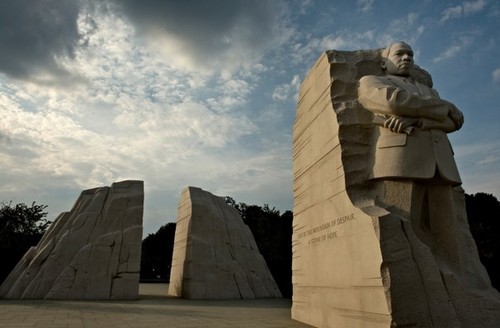
Growing up in America, most children my age veered more towards adopting a Malcolm X disposition, rather than accepting the Martin Luther King Jr. (MLK) ideology. As an adult, it’s irresponsible to believe a chasm existed between these gentlemen; their differences aren’t black and white, they didn't face off as violent virtues versus peaceful virtues. These gentlemen essentially knew and respected one another; choosing one over the other detracts from the fact that their individual achievements ultimately complement one another in the annals of history.
I know of black men who engage in deep intellectual conversations under the influence, sell the influence, and lose all influence in prison. I meet Ivy League black men with the most afro-centric names who openly detest other black people, in very specific terms. On social networks, I follow black men who post pictures of themselves dressed in formal garbs framed with thoughtful captions. We’re all over the place as a people. There’s an obvious yearning for information to self-identify with, somewhere between the entertainment we accept in its place; sometimes the two collide, where we lambaste Bill Cosby for blaming ourselves, or chuckle over the Boondocks’ rendition of future MLK. I’m a big reader, although my library is limited to fictional novels for the most part. Even then, while I have read Malcolm X’s biography, I have not read an MLK biography to date. As conscious as I believe myself to be, I can honestly recite more rap music than civil rights speeches; I would admonish such an admission if it weren’t a normality I were already fighting against.
Yesterday I attended the 7th Annual Martin Luther King Jr. Celebration presented by WNYC at the Brooklyn Museum. This year’s celebration incorporated excerpts of a play titled Reunion, which provides the opportunity for MLK, Malcolm, and Medgar to jointly address issues they were previously denied. The following is a compilation of quotes from the panelists, actors, and my key takeaways:
- Medgar Evers was killed June 12, 1963
- Malcolm X was killed February 21, 1965
- Martin Luther King Jr. was killed April 4, 1968
- Every African American’s bucket list should include a personal expedition to Birmingham, Alabama museums and civil rights sites.
- WNYC was willed unedited, previously unheard of, interviews with MLK, and made the recordings available free online.
- This year marks the 150 year anniversary of the Emancipation Proclamation
- James Baldwin, an openly gay civil rights activist, is my most important post-modern writer – Dr. Peniel Joseph
- In 1963 black people knew they were oppressed, it’s harder for black people to feel their oppression today despite its obvious effects. – Dr. Joseph
- Ms. Baker, an important figure of the SCLC and Grassroots movement, was a strong believer that, strong people don’t need strong leaders. – Dr. Britta Waldschmidt-Nelson
- MLK thoroughly practiced his non-violent ideology, his belief despite the tragedy, dictated that spilled blood was redemptive – Dr. Nelson
- Remember post-Mecca Malcolm, the gentler, less extremist Malcolm. – Dr. Nelson
- Being that he was so disciplined, and rallied black people to take arms in self defense, how would Malcolm feel about the epidemic of black people killing black people? – Dr. Nelson
- Despite their relative omission from this discussion, African American women were the backbone of the civil rights organizations. – Dr. Khalil Gibran Muhammed
- Today, MLK would speak against the war on education and culture, he wouldn’t make it his responsibility to browbeat our children over their poor fashion sense. – Dr. Muhammed
- Dr. Brenda M. Greene is Talib Kweli’s mother, she is a queen and raised a conscious young man.
- Gangster rap music is essentially about low income black people demeaning low income black people. If they were demeaning white people, then it would be an issue. Even demeaning upper class black people would raise a flag; try disrespecting Michelle Obama with rap lyrics, even the demeaned low income black people would raise an eyebrow.
- Modern black culture lacks a meaningful and enriching program for our youth. Our story is not being told, a story is being sold.
Over the course of the event, I’ve been identified as a prophet of personal responsibility. I am not a civil rights activist. My contributions to the cause are to be a role model, volunteer my time, and teach what I know; no one has asked me to speak on their behalf, and I would not do so without their express consent. These men we continue to honor are my heroes nonetheless; their limited lifetime of achievements gave way to limitless lifetimes of achievements. Thank you gentlemen, not on behalf of anyone else, certainly in conjunction with everyone else.



 Posts
Posts


